Exosome Therapy for Hair Loss: Cost, Results and How It Compares to PRP and GFC
Exosome therapy for hair loss involves injecting exosomes, which are tiny signalling vesicles released by stem cells, into the scalp to stimulate dormant follicles. In India it costs roughly Rs 15,000 to Rs 45,000 per session, with three to four sessions typically recommended. It is not FDA approved for hair loss and the clinical evidence is still early.
That last sentence matters, and most clinic websites leave it out. Exosome therapy is genuinely promising, and it is also genuinely new. Both things are true, and you should know both before you spend money on it.
What are exosomes?
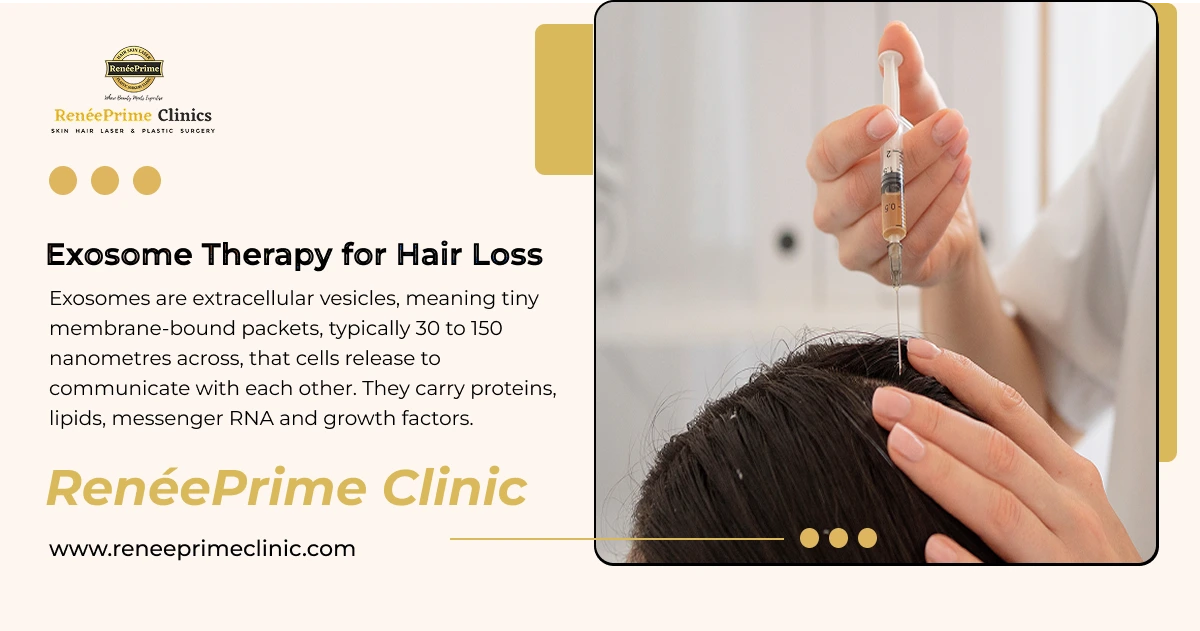
Exosomes are extracellular vesicles, meaning tiny membrane-bound packets, typically 30 to 150 nanometres across, that cells release to communicate with each other. They carry proteins, lipids, messenger RNA and growth factors.
In hair restoration, exosomes are derived from mesenchymal stem cells, most often from umbilical cord tissue or adipose tissue, and processed into an injectable preparation. They are not stem cells themselves. This is an important distinction that clinics often blur.
Exosome therapy is not stem cell therapy. No living cells are transplanted. What is injected is the signalling payload that stem cells produce.
How exosome therapy works for hair loss
The theory is that the growth factors and signalling molecules in exosomes act on the hair follicle in four ways.
- Extending the anagen phase. Encouraging follicles to stay in the active growth phase longer.
- Waking dormant follicles. Prompting miniaturised follicles in the telogen phase back into growth.
- Improving scalp vascularity. Signalling for new blood vessel formation, delivering more nutrients to follicles.
- Reducing follicular inflammation, which contributes to miniaturisation in androgenetic alopecia.
The mechanism is plausible and is supported by laboratory and early clinical work. The gap between plausible mechanism and proven clinical outcome is where exosome therapy currently sits.
The procedure, step by step
- Consultation and scalp assessment. Trichoscopy to measure follicle density and confirm the type of hair loss.
- Scalp preparation. The area is cleaned and topical anaesthetic is applied, usually left for 20 to 30 minutes.
- Microneedling, in some protocols. Creating micro-channels to improve absorption. Not all protocols include this.
- Injection. The exosome preparation is injected into the mid-dermal layer across the affected scalp using a fine needle or mesotherapy gun. This takes 20 to 30 minutes.
- Post-procedure. No dressing required. Mild redness and tenderness for 24 to 48 hours.
Total appointment time: roughly 60 to 90 minutes. There is no downtime and most patients return to work the same day.
How many sessions are needed?
Most protocols use three to four sessions spaced four to six weeks apart, with maintenance sessions every six to twelve months thereafter. Some patients see initial reduction in shedding after the first session, but visible density change is usually assessed at four to six months.
Does exosome therapy actually work? What the evidence shows
Here is the honest position.
What is reasonably established: Laboratory studies show that exosomes derived from mesenchymal stem cells promote hair follicle growth and prolong the anagen phase in cell and animal models. This body of evidence is solid.
What is early: Human clinical evidence consists largely of small studies, case series and clinic-reported outcomes. Large randomised controlled trials comparing exosome therapy against PRP or placebo are limited. Protocols, exosome sources, dosing and concentrations vary widely between manufacturers, which makes results hard to compare across studies.
What is not established: Long-term durability, optimal dosing, and whether exosomes outperform PRP or GFC by enough to justify the price difference.
Regulatory status
Exosome products are not approved by the US FDA for hair loss or for any therapeutic use. The FDA has issued public safety notifications about unapproved exosome products being marketed for a range of conditions. In India, exosome preparations are used in aesthetic practice, and the regulatory framework governing them is less clearly defined than for approved pharmaceuticals.
This does not mean the treatment is unsafe or ineffective. It means the evidence and regulatory approval have not caught up to clinical use. You should factor that into the decision, and any clinic that does not tell you this is not giving you the full picture.
Exosome therapy vs PRP vs GFC vs mesotherapy
This is the comparison most patients actually need.
| Exosome therapy | PRP | GFC | Mesotherapy | |
|---|---|---|---|---|
| What is injected | Stem cell derived signalling vesicles | Your own concentrated platelets | Concentrated growth factors from your own blood | Vitamins, peptides, minerals |
| Source | Donor derived, lab processed | Your own blood | Your own blood | Pharmaceutical compounds |
| Blood draw needed | No | Yes | Yes | No |
| Growth factor concentration | Highest | Baseline | Higher than PRP | Not applicable |
| Sessions typically needed | 3 to 4 | 4 to 6 | 3 to 4 | 6 to 8 |
| Session interval | 4 to 6 weeks | 4 weeks | 4 to 6 weeks | 2 to 3 weeks |
| Evidence base | Early, promising | Strongest of the four | Moderate | Weakest for hair |
| Cost per session in India | Rs 15,000 to Rs 45,000 | Rs 3,000 to Rs 8,000 | Rs 7,000 to Rs 15,000 | Rs 2,500 to Rs 6,000 |
| Allergy or rejection risk | Low, but donor derived | Effectively none, autologous | Effectively none, autologous | Low |
| Regulatory approval for hair loss | Not FDA approved | Not FDA approved, but long clinical use | Not FDA approved | Varies |
Which should you actually choose?
- Early to moderate androgenetic alopecia, budget conscious: PRP has the strongest evidence base and the lowest cost per session. It remains the sensible first line.
- Wanting more than PRP without moving to exosomes: GFC delivers a higher growth factor concentration than PRP from the same autologous source, at moderate cost.
- PRP or GFC tried without adequate response: Exosomes are a reasonable next step, with the caveat that the evidence is early.
- Cannot or prefer not to have blood drawn: Exosomes require no blood draw, unlike PRP and GFC.
- Post-transplant graft support: Exosomes are increasingly used alongside hair transplant surgery to support graft survival and speed the growth phase.
- Advanced loss with significant bald area: No injectable therapy will restore hair where follicles are gone. Surgery is the answer.
Renee Prime offers PRP hair treatment, GFC hair treatment, mesotherapy and exosome therapy. Which is right depends on your stage of loss, not on which is newest.
Exosome therapy cost in India
| Item | Typical cost |
|---|---|
| Per session | Rs 15,000 to Rs 45,000 |
| Full course of 3 sessions | Rs 45,000 to Rs 1,20,000 |
| Full course of 4 sessions | Rs 60,000 to Rs 1,60,000 |
| Annual maintenance session | Rs 15,000 to Rs 45,000 |
| Combined with hair transplant | Add Rs 20,000 to Rs 60,000 |
Why exosome therapy costs more than PRP
The price gap is not clinic markup. Exosome preparations are manufactured products, sourced from a lab, with cold chain storage requirements and per-vial costs the clinic pays regardless of the patient. PRP and GFC are processed from your own blood in-clinic, so the marginal cost is a kit and a centrifuge cycle.
Cost varies significantly by exosome source, concentration and manufacturer. Ask which product a clinic uses and at what concentration. A quote that is far below the market range usually means a lower vesicle count per dose.
Who is a good candidate?
Suitable
- Early to moderate androgenetic alopecia in men and women, where follicles are miniaturised but present
- Diffuse thinning and increased shedding
- Telogen effluvium after illness, stress, pregnancy or crash dieting
- Patients who have not responded adequately to PRP or GFC
- Post-hair-transplant patients wanting to support graft survival
- Patients who cannot undergo a blood draw
Not suitable
- Advanced baldness where follicles are absent. No injectable regrows hair from bare scalp
- Active scalp infection or inflammatory scalp disease
- Untreated underlying causes such as thyroid disorder, iron deficiency or PCOS. Treat the cause first
- Pregnancy and breastfeeding
- Active malignancy or immunosuppression, without oncologist clearance
- Anyone seeking a one-session fix
The honest limitation: exosome therapy improves the performance of follicles that still exist. It does not create new follicles. If your scalp is shiny and bare in an area, a transplant is the only option that puts hair there.
Side effects and safety
Reported side effects are mild and short-lived.
| Side effect | Frequency | Duration |
|---|---|---|
| Redness at injection sites | Common | 24 to 48 hours |
| Mild swelling of the scalp or forehead | Common | 1 to 3 days |
| Tenderness or scalp soreness | Common | 1 to 2 days |
| Pinpoint bruising | Occasional | 3 to 7 days |
| Headache | Occasional | 24 hours |
| Temporary increased shedding | Occasional | 2 to 4 weeks |
| Infection at injection site | Rare | Requires treatment |
| Allergic reaction | Rare | Requires treatment |
The theoretical risk that distinguishes exosomes from PRP and GFC is that the product is donor derived rather than autologous. That introduces an immunological question that autologous treatments do not have. In practice, reported reactions are rare, but the long-term safety data does not yet exist because the treatment has not been in widespread use long enough.
Aftercare: avoid washing the scalp for 24 hours, avoid swimming, sauna and heavy exercise for 48 hours, avoid direct sun for 48 hours, and do not apply minoxidil or other topicals for 24 hours.
What results to expect, and when
| Timeframe | What you should notice |
|---|---|
| Weeks 2 to 4 | Reduction in daily shedding, often the first sign |
| Weeks 6 to 8 | Improved scalp condition, hair feels less brittle |
| Months 3 to 4 | Fine new growth becomes visible in thinning areas |
| Months 4 to 6 | Measurable density change, best assessed on trichoscopy against baseline |
| Months 6 to 12 | Peak effect. Maintenance planning begins |
How long does it last? Reported durability is roughly twelve to eighteen months from a completed course before density begins to decline. Maintenance sessions extend this. Like every non-surgical hair treatment, exosome therapy manages an ongoing condition rather than curing it. Stopping treatment means gradual return toward your untreated baseline.
Ask for baseline trichoscopy. Density change of 10 to 15 percent is real and worthwhile, but it is difficult to see in a mirror. Without a measured baseline you cannot tell whether the treatment worked, which is exactly why some clinics do not take one.
Frequently asked questions
1. What is exosome therapy for hair loss?
Exosome therapy involves injecting exosomes, tiny signalling vesicles derived from mesenchymal stem cells, into the scalp. They carry growth factors and messenger RNA that signal hair follicles to extend their growth phase, improve local blood supply and reduce follicular inflammation.
2. Is exosome therapy FDA approved for hair loss?
No. Exosome products are not FDA approved for hair loss or any therapeutic indication, and the FDA has issued safety notifications regarding unapproved exosome products. Exosome therapy is used in aesthetic practice in India and elsewhere, but it should be understood as an emerging treatment rather than an approved one.
3. Does exosome therapy work for hair loss?
Laboratory and early clinical evidence is promising, showing prolonged anagen phase and improved follicle activity. Large randomised controlled trials in humans are limited, and protocols vary widely between manufacturers. It appears to help patients with miniaturised but surviving follicles. It cannot regrow hair where follicles are gone.
4. How much does exosome therapy for hair loss cost in India?
Roughly Rs 15,000 to Rs 45,000 per session, with a typical course of three to four sessions costing Rs 45,000 to Rs 1,60,000. Cost varies by exosome source, concentration and manufacturer.
5. Is exosome therapy better than PRP?
It delivers a higher concentration of growth factors and requires no blood draw, but PRP has a considerably stronger evidence base and costs a fraction as much per session. For most patients with early to moderate loss, PRP remains the sensible first line. Exosomes are a reasonable option when PRP or GFC has not produced an adequate response.
6. How many exosome sessions do I need?
Most protocols use three to four sessions spaced four to six weeks apart, followed by maintenance sessions every six to twelve months.
7. How long does exosome hair therapy last?
Reported durability is around twelve to eighteen months from a completed course before density begins to decline. Maintenance sessions extend this. It manages an ongoing condition rather than curing it.
8. What are the side effects of exosome therapy for hair?
Most are mild and resolve within 48 hours: redness, mild swelling, tenderness and occasional pinpoint bruising. Temporary increased shedding can occur in the first few weeks. Infection and allergic reaction are rare. Because the product is donor derived rather than made from your own blood, it carries a theoretical immunological consideration that PRP and GFC do not.
9. Is exosome therapy the same as stem cell therapy?
No. No living cells are injected. Exosomes are the signalling vesicles that stem cells release. Clinics that market exosome therapy as stem cell therapy are describing it inaccurately.
10. Can exosome therapy be combined with a hair transplant?
Yes, and this is one of its more established uses. Exosomes applied during or after transplant surgery are used to support graft survival and shorten the time to visible growth.
11. Does exosome therapy hurt?
Discomfort is mild. Topical anaesthetic is applied for 20 to 30 minutes beforehand, and most patients describe the injections as brief stinging. The scalp feels tender for a day or two afterwards.
12. Can women have exosome therapy?
Yes. It is used for female pattern hair loss and for diffuse thinning, and it is often more suitable for women than surgery, since female hair loss is typically diffuse rather than patterned. It is not given during pregnancy or breastfeeding.
Considering exosome therapy in Mumbai?
At Renee Prime we assess whether exosome therapy is genuinely the right treatment for your stage of hair loss, rather than defaulting to the newest option. Many patients get better value from PRP or GFC, and we will tell you when that is the case.
Every course starts with baseline trichoscopy so that results can be measured rather than guessed at.
Book a consultation or call +91 95947 15522. Clinics at Charni Road, South Mumbai and Vasai West.