Hair Transplant in India vs Turkey: An Honest Comparison (2026)
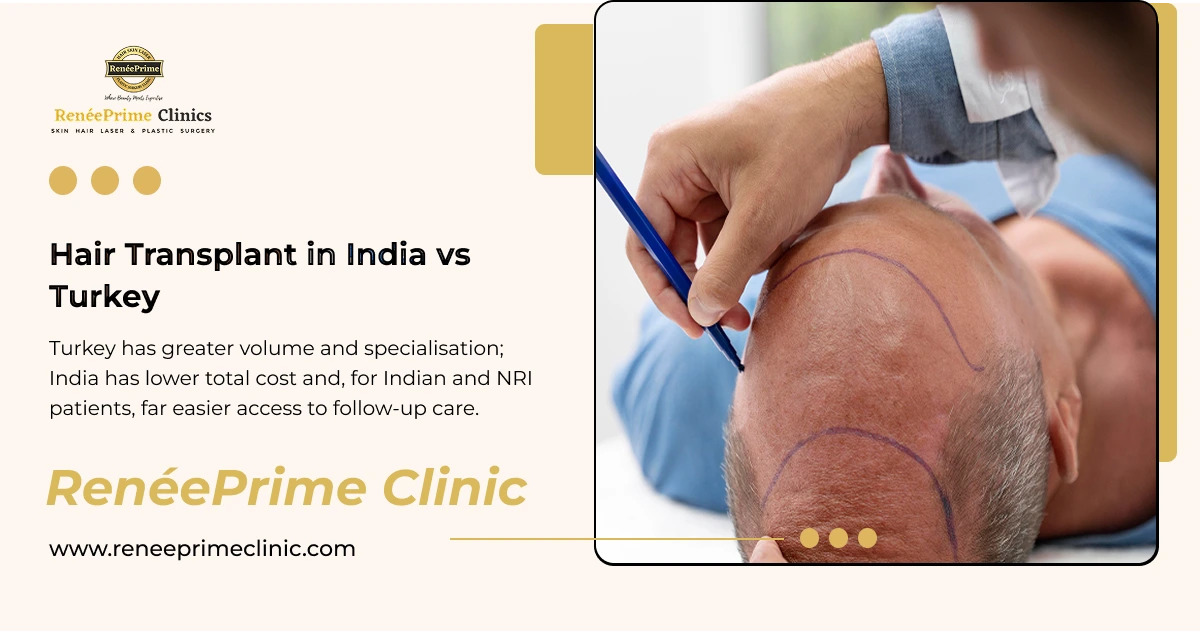
Once travel and accommodation are included, a hair transplant in India typically costs less than the same procedure in Turkey, at roughly Rs 75,000 to Rs 2,50,000 versus Rs 2,25,000 to Rs 5,00,000. Turkey has greater volume and specialisation; India has lower total cost and, for Indian and NRI patients, far easier access to follow-up care.
We are an Indian clinic, so read this knowing that. What follows is written to be accurate rather than flattering, because if you make this decision on marketing copy you may end up in the group of patients who come to us for repair work later.
Why Turkey became the hair transplant capital
Turkey performs an enormous volume of hair transplants, and the reasons are structural rather than accidental.
- Government backing. Turkey actively promoted medical tourism as an economic policy, with accreditation programmes and infrastructure investment.
- Currency advantage. Lira depreciation made Turkish pricing extremely attractive to European and British patients in particular.
- Volume creates skill. Istanbul clinics perform transplants at a scale that builds genuine technical proficiency, especially in FUE.
- Package model. All-inclusive packages covering hotel, transfers, translator and procedure removed the friction from booking.
- Marketing scale. Turkish clinics invested heavily in international digital marketing over a decade.
Credit where it is due. Turkey’s top-tier clinics are excellent. Some of the best FUE surgeons in the world practise in Istanbul, and the specialisation that comes from doing only hair transplants, at high volume, produces real expertise. Anyone who tells you Turkish hair transplants are uniformly bad is selling you something.
The problem is not Turkey. The problem is that the same market that produced world-class clinics also produced a large tier of high-volume package operations, and from an international patient’s website they can be difficult to tell apart.
Cost compared, properly
Most comparisons stop at the procedure price. That is the wrong number. Here is the total cost of ownership.
India, for a domestic patient
| Item | Cost |
|---|---|
| Procedure, 2,500 grafts FUE | Rs 90,000 to Rs 2,00,000 |
| Travel, domestic | Rs 0 to Rs 15,000 |
| Accommodation, 2 nights | Rs 0 to Rs 12,000 |
| Follow-up visits | Included |
| Total | Rs 90,000 to Rs 2,27,000 |
Turkey, for an Indian patient
| Item | Cost |
|---|---|
| Procedure package, 2,500 grafts FUE | Rs 1,80,000 to Rs 3,50,000 |
| Return flights from India | Rs 40,000 to Rs 80,000 |
| Accommodation, if not in package | Rs 0 to Rs 40,000 |
| Visa and travel insurance | Rs 8,000 to Rs 15,000 |
| Meals and local transport | Rs 15,000 to Rs 30,000 |
| Follow-up, requires return travel | Rs 40,000 upwards, or not done |
| Total | Rs 2,43,000 to Rs 5,15,000 |
Turkey, for a UK or US patient
| Item | Cost |
|---|---|
| Procedure package, 2,500 grafts | $2,700 to $6,000 |
| Return flights from UK | $250 to $600 |
| Extras and meals | $300 to $600 |
| Total | $3,250 to $7,200 |
India, for a UK or US patient
| Item | Cost |
|---|---|
| Procedure, 2,500 grafts | $1,100 to $2,400 |
| Return flights from UK | $600 to $1,100 |
| Accommodation, 4 nights | $200 to $600 |
| Extras and meals | $200 to $400 |
| Total | $2,100 to $4,500 |
The conclusion the numbers support: for Indian and NRI patients, India is substantially cheaper once travel is counted, and it is not close. For UK and European patients, India is still cheaper than Turkey but the gap narrows, and Turkey’s shorter flight time is a genuine advantage. For patients travelling from the Gulf, both are comparable and the decision should turn on clinic quality rather than cost.
Why is Turkey so cheap for hair transplants?
This question gets asked constantly, and it has a legitimate answer and a less legitimate one.
The legitimate reasons
- Lower labour and facility costs than Western Europe.
- Currency depreciation against the pound, euro and dollar.
- Genuine economies of scale from very high procedure volume.
- Intense domestic competition compressing margins.
The less legitimate reasons
- Technician-led procedures. In many Turkish clinics the surgeon designs the hairline and performs the incisions, then technicians carry out extraction and implantation. This is legal under Turkish regulation and it is how the volume is achieved. It is not necessarily bad, and skilled technicians do good work. But it should be disclosed, and at the budget end it often is not.
- Parallel operating. Several patients treated simultaneously, which increases the time grafts spend outside the body.
- Unlimited graft packages. A fixed price for “maximum grafts” creates a direct incentive to overharvest the donor area, which is the damage that cannot be undone.
- No follow-up cost. The price is low partly because aftercare effectively ends when you board your flight.
Every one of these exists in Indian metros too, at the budget end of the market. The model, not the country, is what determines your outcome.
The comparison that actually matters
| Factor | India | Turkey |
|---|---|---|
| Procedure cost | Lower | Low, higher than India |
| Total cost for Indian or NRI patient | Considerably lower | Higher after travel |
| Total cost for UK or EU patient | Lower | Slightly higher, shorter flight |
| Flight time from UK | 9 to 10 hours | 4 hours |
| Flight time from India | Not applicable | 6 to 8 hours |
| Top-tier surgeon quality | Excellent | Excellent |
| Procedure volume and specialisation | High | Very high |
| Who performs extraction and implantation | Varies, ask | Frequently technicians |
| Language barrier for Indian patients | None | Translator dependent |
| Follow-up access for Indian patients | Straightforward | Requires return travel |
| Recourse if something goes wrong | Domestic legal and medical channels | Cross-border, impractical for most |
| Ability to return for a second session | Easy | Expensive |
| Hair type familiarity for Indian hair | Direct daily experience | Varies by clinic |
The two factors most people underweight
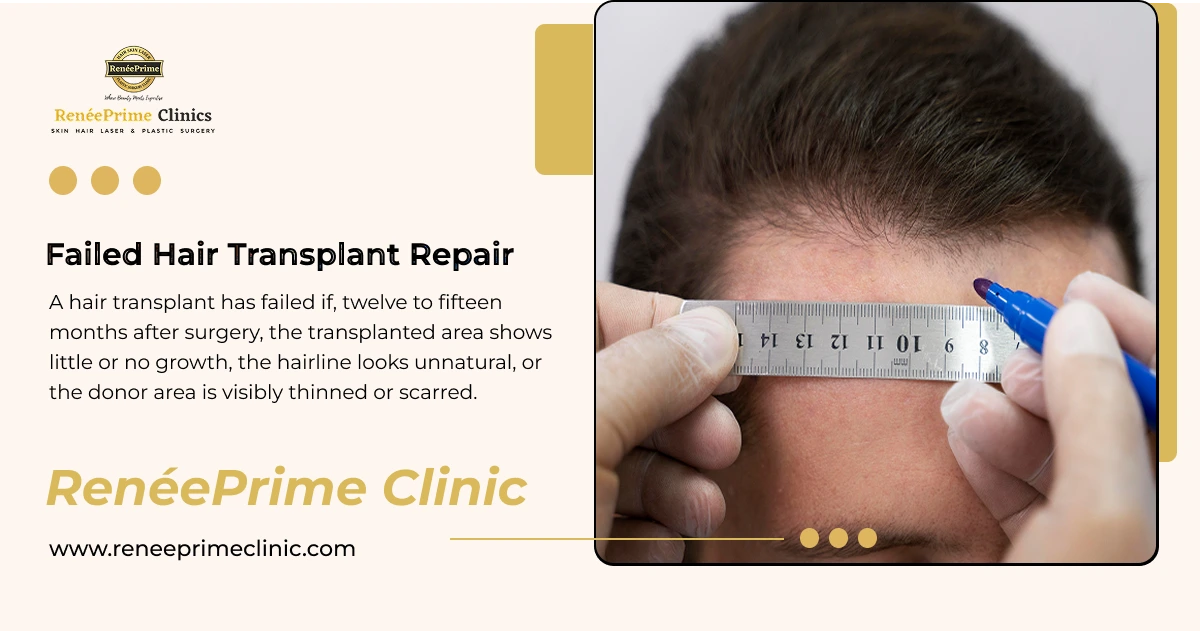
Follow-up. A hair transplant is not a one-day event. It is a twelve to fifteen month process with a healing phase, a shedding phase, and a growth phase where things can go wrong and be corrected. If your surgeon is 6,000 kilometres away, your follow-up is a WhatsApp photo. That is adequate when everything is normal and useless when it is not.
Recourse. If your result is poor, pursuing a clinic in another jurisdiction is impractical for almost everyone. In India you have domestic medical council and consumer channels. This rarely matters, and it matters enormously when it does.
One factor that favours Turkey honestly
If you are travelling from the UK or Europe, Turkey is a four hour flight against nine or ten to India. For a procedure with a tender scalp and a ten day window where grafts must not be disturbed, a shorter flight home is a real clinical advantage, not just a convenience.
Hair type: a genuine technical point
Indian and South Asian hair differs from Northern European hair in ways that affect surgical planning. It is typically coarser, with a larger shaft diameter, and often has a natural curl or wave at the follicle level. Follicular unit grouping and density per square centimetre also differ.
Coarser hair has an advantage. It provides better visual coverage per graft, meaning fewer grafts are needed for the same apparent density. But curl affects the angle of extraction, and a surgeon unfamiliar with the follicle curvature of South Asian hair will transect more follicles during extraction.
Surgeons who work with a given hair type daily handle it better. This applies in both directions, and it is a legitimate argument for Indian patients being treated in India.
The questions to ask any clinic, in either country
This is the part that actually determines your result. Ask all of these, and ask for the answers in writing.
- Who physically performs the extraction and the implantation, the surgeon or technicians?
- How much of my procedure will the surgeon personally perform?
- How many patients are scheduled on my surgery date?
- What is my measured donor density, and what is my safe lifetime graft budget?
- Is this an estimated graft count or a guaranteed one, and how is it verified?
- What punch size do you use?
- What is the total all-inclusive price, including anaesthesia, medication, follow-up and taxes?
- How many follow-up reviews are included, and how are they conducted?
- What is your policy if graft survival is poor?
- Can I see before and after photographs at twelve months, including donor area photos?
A clinic that answers all ten clearly is a good clinic, regardless of which country it is in. A clinic that deflects on question one or four is the same risk anywhere.
Who should choose which
India makes more sense if you
- Live in India or are an NRI with family here
- Want the lowest total cost including travel
- Value being able to physically return for follow-up
- Want recourse within a familiar legal and medical system
- Have South Asian hair and want a surgeon who works with it daily
- May need a second session later
Turkey makes more sense if you
- Are travelling from the UK or Europe and want the shortest flight
- Have identified a specific top-tier Istanbul surgeon with verifiable credentials and twelve-month result photography
- Want an all-inclusive package with travel logistics handled
- Are comfortable managing follow-up remotely
Neither, if you
- Are being sold an unlimited graft package
- Cannot get a straight answer about who performs the surgery
- Have not had your donor density measured before receiving a graft count
- Are choosing on price alone
Frequently asked questions
1. Is a hair transplant cheaper in Turkey or India?
India. For an Indian patient, a 2,500 graft procedure costs roughly Rs 90,000 to Rs 2,27,000 including travel, versus Rs 2,43,000 to Rs 5,15,000 for the same procedure in Turkey once flights, visa, accommodation and meals are included. For UK patients India is still cheaper, though the gap narrows.
2. Why is a hair transplant so cheap in Turkey?
A combination of lower labour and facility costs, currency depreciation, and very high procedure volume. At the budget end it is also achieved through technician-led procedures, operating on several patients simultaneously, and unlimited graft packages that create an incentive to overharvest the donor area.
3. Is a hair transplant in Turkey worth it?
At a top-tier Istanbul clinic with a verifiable surgeon, yes, particularly for European patients who benefit from the four hour flight. At the budget package end, the risk of donor overharvesting and poor graft survival is real, and cross-border recourse is impractical. The clinic matters far more than the country.
4. Which country is better for a hair transplant?
There is no single answer. The best available surgeon you can reach and return to is better than the best country. For Indian and NRI patients, India wins on total cost, follow-up access and recourse. For UK and European patients, Turkey wins on flight time while India wins on cost.
5. Is Turkey better than India for hair transplant quality?
At the top tier, quality is comparable. Both countries have world-class surgeons and both have high-volume budget operations. The meaningful difference is not national but structural: whether the surgeon performs your procedure, how many patients are operated on that day, and whether your donor area is protected.
6. How much does a hair transplant in Turkey cost in Indian rupees?
Roughly Rs 1,80,000 to Rs 3,50,000 for the procedure package for 2,500 grafts, rising to Rs 2,43,000 to Rs 5,15,000 once return flights, visa, accommodation and meals are added.
7. Do Turkish clinics use technicians instead of surgeons?
In many clinics, yes. The surgeon typically designs the hairline and makes the recipient incisions, with technicians performing extraction and implantation. This is permitted under Turkish regulation and skilled technicians produce good work. What matters is that it is disclosed. Ask directly and ask for the answer in writing. The same question should be asked of Indian clinics.
8. Is my hair type a factor in choosing a country?
It can be. South Asian hair is typically coarser with follicle-level curl, which affects extraction angle and transection risk. Coarser hair also gives better coverage per graft. A surgeon who works with your hair type daily will handle it more reliably.
9. What happens if my transplant goes wrong abroad?
Practically, your options are limited. Cross-border medical complaints are slow, expensive and rarely pursued to a conclusion. Most patients with a poor overseas result end up paying a second surgeon at home for corrective work, which costs more than the original procedure. See our guide to failed hair transplant repair.
10. Can I get a hair transplant in India as an international patient?
Yes. India treats a substantial volume of international hair restoration patients. Plan for four to five nights: consultation and surgery, a rest day, the first post-operative wash and review, then travel. See our international patient services.
11. How long should I stay in the country after surgery?
Minimum three nights, ideally four to five. Grafts anchor over roughly the first ten days, and the first post-operative wash and review should happen before you fly. A longer flight home means a longer recommended stay.
Considering a hair transplant in Mumbai?
Renee Prime treats both domestic and international patients. Dr. Sulochana S. Khogare has performed over 3,800 hair transplants across sixteen years and performs the extraction and implantation personally rather than delegating the procedure.
We will give you a measured donor density assessment and an honest graft count before quoting, and we will tell you if a transplant is not the right answer for your stage of loss.
Book a consultation or call +91 95947 15522.
Clinics at Charni Road, South Mumbai and Vasai West. International patient services.