Failed Hair Transplant: Signs, Causes and What Repair Actually Involves
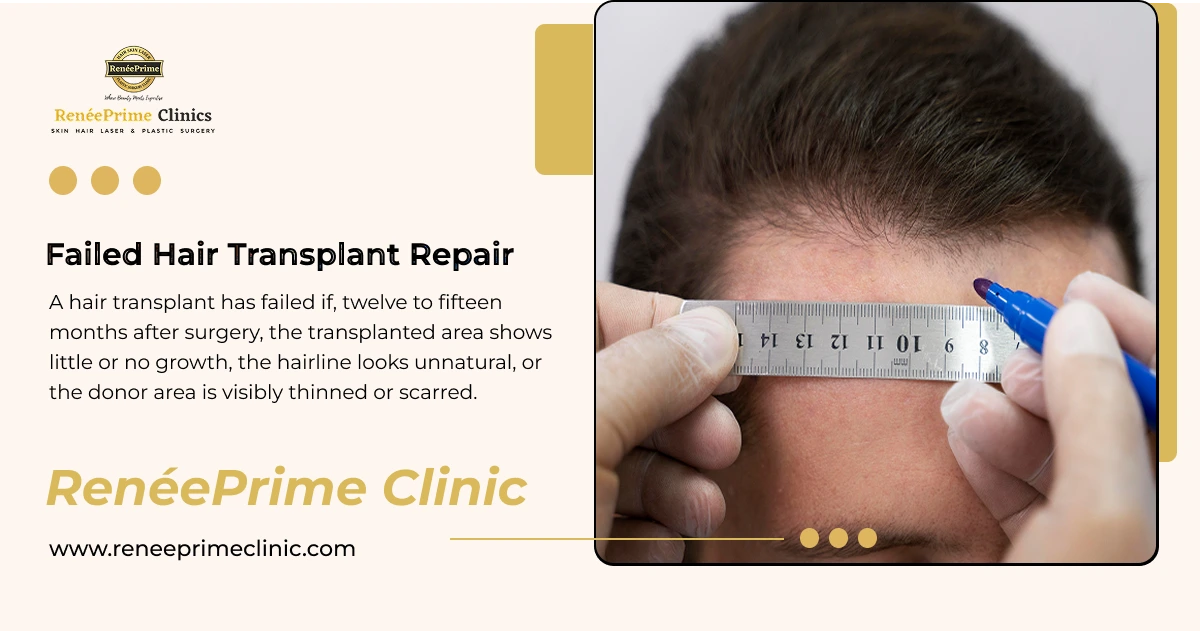
A hair transplant has failed if, twelve to fifteen months after surgery, the transplanted area shows little or no growth, the hairline looks unnatural, or the donor area is visibly thinned or scarred. Most failures are correctable, but repair is harder than the original procedure because donor supply is limited.
If you are reading this six months after your surgery and panicking, read the next section first. A large proportion of the people who contact us about a “failed” transplant have a perfectly normal transplant that is not finished growing.
First: it may not have failed
Transplanted hair follows a predictable timeline that looks alarming if nobody explained it to you.
| Time since surgery | What you should be seeing |
|---|---|
| Week 1 to 2 | Scabbing, redness, swelling. Grafts visible as tiny crusts |
| Week 2 to 6 | Transplanted hairs shed. This is normal and expected |
| Month 2 to 3 | The transplanted area looks bald again. This is the “ugly duckling” phase |
| Month 3 to 4 | First new growth appears, fine and colourless |
| Month 6 | Roughly 40 to 50 percent of final density |
| Month 9 | Roughly 70 to 80 percent of final density |
| Month 12 to 15 | Final result. Hair thickens and takes on normal texture |
Do not judge a hair transplant before twelve months. Judging at six months is the single most common reason people believe their procedure failed when it has not. Crown transplants are slower still and can take fifteen to eighteen months.
Signs of a failed hair transplant
If you are past the twelve month mark, these are the genuine warning signs.
1. Patchy or absent growth
Sparse growth with visible gaps in the transplanted zone, or areas where nothing grew at all. If more than roughly 20 percent of the treated area has no growth at twelve months, graft survival was poor.
2. An unnatural hairline
The most common cosmetic failure, and the hardest to hide. Watch for a hairline that runs in a straight line rather than an irregular one, hair that grows at the wrong angle or points forward, thick multi-hair grafts placed at the front edge where single hairs belong, and a hairline set too low for your age.
A natural hairline is deliberately irregular, uses single-hair follicular units along the leading edge, and follows the natural forward-and-down angle of the original hair.
3. “Doll’s hair” or pluggy appearance
Visible clumps of hair with bald scalp between them. This is caused by grafts placed too far apart or grafts containing too many hairs each. It is most often seen in older procedures but still happens where punch sizes are too large.
4. Donor area damage
Look at the back and sides of your head in a mirror with a second mirror behind you. Signs of overharvesting include visible white dots, patchy thinning, a moth-eaten appearance, or a widened linear scar if you had FUT.
Donor damage is the most serious failure because it limits every future repair option. You cannot regrow a donor area.
5. Scarring in the recipient area
Raised, pitted or shiny scarring where grafts were placed. Usually caused by incisions that were too large, or by infection during healing.
6. Continued loss around the transplant
Sometimes the transplant worked but native hair behind it kept receding, leaving an island of transplanted hair with a bald gap behind it. This is a planning failure rather than a surgical one, and it happens when a surgeon transplants an aggressive hairline in a young patient without accounting for future loss.
Why hair transplants fail
Understanding the cause matters, because it determines whether repair is possible and what it will involve.
Surgical causes
- Poor graft handling. Follicles die if they spend too long outside the body, dry out, or are crushed during extraction and placement. This is the leading cause of poor survival and it correlates directly with rushed, high-volume sessions.
- Punch size too large. A larger punch extracts faster but damages surrounding follicles and leaves more visible donor dotting.
- Incisions too deep, too shallow or wrongly angled. Depth affects survival. Angle affects whether the result looks natural.
- Overharvesting the donor area. Taking more grafts than the donor can safely give in order to hit a promised graft count.
- Dense packing beyond blood supply. Grafts placed too close together compete for oxygen and some die.
- Inexperienced operators. Where technicians rather than the surgeon perform the bulk of extraction and implantation without close supervision.
Planning causes
- Wrong candidate. Diffuse unpatterned alopecia and active alopecia areata are poor candidates for surgery. Transplanting into them produces poor results regardless of technique.
- Untreated underlying cause. Thyroid disorders, iron deficiency and PCOS drive hair loss that surgery does not fix.
- A hairline designed for today, not for age fifty. The commonest planning failure in young patients.
- No medical therapy alongside. Without treatment to hold native hair, loss continues around the transplanted zone.
Patient-side causes
- Smoking. Nicotine constricts blood vessels and measurably reduces graft survival. Most surgeons ask patients to stop for two weeks before and at least a month after.
- Disturbing the grafts in the first ten days. Scratching, rubbing or knocking the recipient area before grafts anchor.
- Infection from poor aftercare.
- Stopping prescribed medication immediately after surgery.
How common is failure? At an experienced clinic with proper graft handling, graft survival typically runs 90 to 95 percent, and outright failure is uncommon. The failure cases we see in clinic are overwhelmingly from high-volume, low-cost operations, whether in India or abroad.
Why so many failed transplants come from abroad
A significant share of repair cases in Indian clinics involve procedures performed overseas at package rates. The pattern is consistent.
- A single price is quoted for an unlimited or very high graft count, which incentivises overharvesting.
- The surgeon designs the hairline and then leaves, with technicians performing extraction and implantation.
- Multiple patients are operated in parallel, so graft time outside the body increases.
- The patient flies home within three to five days, so nobody sees the healing phase.
- There is no realistic route to follow-up or recourse when something goes wrong.
None of this is inherent to any country. It is inherent to the volume package model. The same model exists in Indian metros. The question to ask any clinic anywhere is the same one: who physically performs the extraction and implantation, and how many patients are being operated on that day.
Can a failed hair transplant be repaired?
Yes, in most cases, but repair is constrained by three things: how much viable donor hair remains, how much scarring is present, and how much of the failure is scarring versus simply poor density.
Repair is harder than a primary procedure. The recipient area now has scar tissue, which has reduced blood supply and holds grafts less reliably. The donor area has already been drawn on. And you are correcting someone else’s design rather than starting from a clean scalp.
This is why repair work should go to a more experienced surgeon than the original, not a cheaper one.
Repair options, and when each applies
| Option | Best for | Timing | Limitations |
|---|---|---|---|
| Corrective FUE session | Patchy density, thin coverage, filling gaps | 12 months after original | Needs remaining donor supply |
| Graft excision and redistribution | Pluggy grafts, wrong-angle hair at hairline | 12 months after original | Some grafts lost in the process |
| Hairline redesign | Unnatural, straight or too-low hairline | 12 months after original | Often combined with excision |
| Scalp micropigmentation | Donor scarring, camouflaging low density | 6 to 12 months after original | Cosmetic camouflage, not real hair |
| Body hair transplant | Depleted scalp donor supply | Case by case | Coarser texture, lower survival |
| Biofibre implants | No viable donor supply remaining | Case by case | Requires ongoing maintenance |
| Medical therapy alone | Failure driven by ongoing native loss | Immediate | Does not fix surgical defects |
| SMP plus short haircut | Extensive donor damage, limited options | Any time | Requires committing to short hair |
Wait at least twelve months before any repair surgery. Two reasons. The original result is not final before then, and operating into healing tissue reduces survival of the repair grafts too.
A note on scalp micropigmentation
For many failed transplant patients, particularly those with donor damage, SMP is the more sensible answer than more surgery. It creates the appearance of density by pigmenting the scalp, works well over scarring, requires no donor supply, and can be combined with a short haircut for a genuinely good result.
Renee Prime offers scalp micropigmentation in Mumbai, and we recommend it over further surgery whenever donor supply cannot support a proper repair.
What a repair consultation should involve
A surgeon assessing repair work needs considerably more information than for a primary case. Expect the following.
- Donor area assessment under magnification, measuring remaining density and follicular unit count per square centimetre.
- Scarring assessment across both recipient and donor zones.
- Review of your original operative record, including graft count, technique and punch size, if you can obtain it.
- Photographic review of your pre-operative state if available.
- Realistic graft budget, meaning how many grafts can safely still be taken across your lifetime, not just this session.
- A written plan stating what can be corrected, what cannot, and what the result will realistically look like.
If a clinic offers you a repair quote without measuring your donor density, walk away. That is the same shortcut that caused the original failure.
Questions to ask before booking repair surgery
- How many repair and corrective cases have you personally performed?
- What is my remaining safe donor supply, measured, not estimated?
- Can you correct the hairline design, or only add density?
- Will you excise the misplaced grafts, and how many will be lost in that process?
- Would SMP give me a better result than more surgery in my case?
- What will this look like at twelve months, and what will it not fix?
- Do you perform the extraction and implantation yourself?
What repair costs in India
Repair work costs more per graft than a primary procedure, typically 20 to 40 percent more. The reasons are practical. Sessions are slower, graft excision adds time, scarred tissue needs more careful incision placement, and the planning is more complex.
| Repair type | Typical grafts | Cost range |
|---|---|---|
| Hairline correction and redesign | 800 to 1,800 | Rs 45,000 to Rs 1,40,000 |
| Density fill of patchy area | 1,200 to 2,500 | Rs 65,000 to Rs 1,90,000 |
| Full corrective session | 2,000 to 3,500 | Rs 1,10,000 to Rs 2,80,000 |
| Graft excision plus redistribution | Case dependent | Rs 60,000 upwards |
| SMP over donor scarring | Not applicable | Rs 25,000 to Rs 80,000 |
For general procedure pricing, see our guides to hair transplant cost in India and hair transplant cost in Mumbai.
How to avoid this the first time
If you are reading this before your first procedure, these are the checks that matter most.
- Verify the surgeon on the state medical council register.
- Ask, in writing, who performs extraction and implantation.
- Ask how many patients are scheduled the same day.
- Ask for the punch size used and the expected graft survival rate.
- Look at before and after photos taken at twelve months, not six.
- Ask to see donor area photos after healing, not just the front of the head.
- Be suspicious of unlimited graft packages and of graft counts promised before your donor density has been measured.
- Choose a surgeon you can physically return to for follow-up.
Our full checklist is in our guide to choosing a hair transplant clinic in Mumbai.
Frequently asked questions
1. How do I know if my hair transplant failed?
Wait until twelve months post-surgery. Failure is indicated by little or no growth in the transplanted area, visible gaps covering more than roughly 20 percent of the treated zone, an unnatural hairline, or visible donor area thinning. Before twelve months, sparse growth is normal and expected.
2. Can a hair transplant fail after 1 year or 2 years?
Transplanted follicles are taken from DHT-resistant donor areas and are permanent. If hair loss appears after a successful result, it is almost always the surrounding native hair continuing to recede, not the transplanted hair failing. This is why medical therapy alongside surgery matters.
3. Why do hair transplants fail?
The most common causes are poor graft handling during surgery, overharvesting of the donor area, incorrect incision angle or depth, transplanting an unsuitable candidate, and smoking during the healing period. Rushed high-volume sessions account for a disproportionate share of failures.
4. Can a bad hair transplant be fixed?
Usually yes, if enough viable donor hair remains. Repair options include a corrective FUE session, excision and redistribution of badly placed grafts, hairline redesign, scalp micropigmentation, and in cases of depleted donor supply, body hair transplant or Biofibre implants.
5. How long should I wait before repair surgery?
At least twelve months from the original procedure. The first result is not final before then, and operating into tissue that is still healing reduces the survival of the repair grafts as well.
6. What is the failure rate of hair transplants?
At an experienced clinic with careful graft handling, graft survival is typically 90 to 95 percent and outright failure is uncommon. Failure rates rise sharply with rushed sessions, large graft counts performed by small teams, and unsupervised technician-led procedures.
7. Does smoking cause hair transplant failure?
Smoking meaningfully reduces graft survival. Nicotine constricts blood vessels, reducing oxygen delivery to newly placed grafts during the critical first two weeks. Most surgeons ask patients to stop for at least two weeks before and one month after surgery.
8. Can scalp micropigmentation fix a failed hair transplant?
SMP does not grow hair, but it is often the best available answer. It camouflages donor scarring, creates the appearance of density over thin areas, requires no donor supply, and works well combined with a short haircut. For patients with depleted donor areas, it frequently produces a better outcome than further surgery.
9. Why do so many failed transplants come from abroad?
The pattern is driven by the volume package model rather than by geography. Unlimited-graft packages incentivise overharvesting, technicians often perform most of the procedure, several patients are operated in parallel, and the patient flies home before healing is visible. The same model exists in Indian cities.
10. Will a repair look completely natural?
It depends on donor supply and scarring. A well-executed repair by an experienced surgeon can produce a natural result in most cases. Where donor supply is depleted or scarring is extensive, the honest answer is significant improvement rather than a perfect result. Any surgeon promising perfection before examining your donor area is overselling.
11. Can I get a repair if my donor area is damaged?
Options narrow but do not disappear. Body hair transplant can supplement a depleted scalp donor area, Biofibre implants require no donor hair at all, and scalp micropigmentation camouflages both thinning and scarring. A measured donor assessment determines which applies.
Book a repair consultation
If you are unhappy with a previous hair transplant, we offer a dedicated repair assessment including donor density measurement under magnification, scarring evaluation, and a written plan setting out what can and cannot be corrected.
Dr. Sulochana S. Khogare has performed over 3,800 hair transplants across sixteen years, including corrective work on procedures performed elsewhere in India and abroad.
Book a consultation or call +91 95947 15522.
Clinics at Charni Road, South Mumbai and Vasai West.